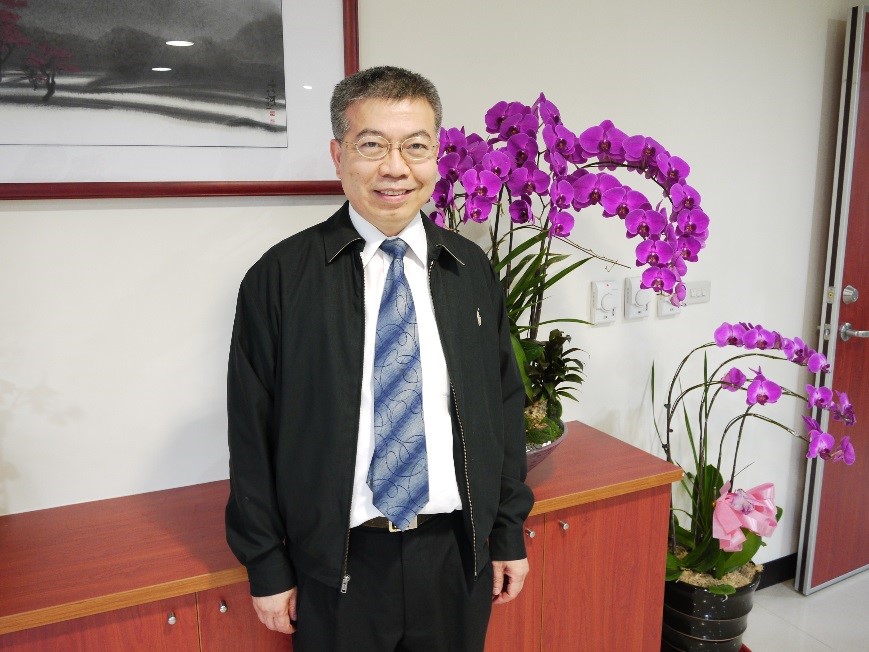
Sea-Fue Wang is a Professor of Materials Science and Engineering at National Taipei University of Technology, Taiwan. He graduated from National Taipei Institute of Technology, Taiwan, in 1979. He received his M.S. in Metallurgical Engineering from South Dakota School of Mines and Technology in 1985 and his Ph.D. in Ceramic Science from Pennsylvania State University in 1991. From 1991 to 1993, he was a Research Associate at Materials Research Laboratory, Pennsylvania State University. Prior to Joining National Taipei University of Technology in 1997, he was a Senior Research and Development Engineer at Vitramon Incorporated, a company of Vishay. He had served as Department Head for 6 years, Dean of Engineering College for 3 years and Vice-President of the University for 4 years. His research interests include processing, characterization, and theoretical understanding of electronic, magnetic, and optical ceramics.
Professor Wang has been recognized worldwide for his contribution in the development of low-fire microwave ceramics, formulations for multilayer ceramic capacitors (MLCCs) and inductors (MLCIs), solid oxide fuel cells (SOFCs), and ceramic films for resistive random access memories (RRAMs). These outstanding results have been published in SCI journal papers and transferred as technical patents. He was the general chairs of 10th Asian Meeting on Electroceramics (AMEC-2016), International Union of Materials Research Societies-International Conference on Electronic Materials 2014 (IUMRS-ICEM 2014) and 2013 International Thin Films Conference, and currently he serves as the chairman of organizing Committee for the 4th International Conference on Powder Metallurgy in Asia (APMA-2017). He holds more than 50 national and international patents and 257 scientific journal publications [3650 Citation (without self-citation), h-index: 33, ISI Web of Science on the 2nd of Jan. 2019, and Google Scholar: h-index 36, citations 4411].
Professor Wang is specialized in formulations-processing-microstructure-properties relationships of electroceramics. More than ten dielectric capacitors formulations, such as X9R, X8R, X7T, COG and Y5V capacitors and low-fire and ultralow-fire microwave ceramics such as Zn2Te3O8-TiTe3O8, BaTe4O9-TiTe3O8,and BiSbO4-Bi2Mo2O9 compositions, have been successfully developed by him. For instance, he developed a non-reducible high-temperature stable X9R dielectrics based on 0.95BaTiO3-0.05Ba2LiTa5O15 composition with a dielectric constant of 895, tan of 1.01% and 7.1%, TCCs of -3.04% and -14.80%, and electrical resistivities of 9.9x10¹² and 1.6x10¹² Ω-cm, respectively at 25C and 200C. He also developed BaTe4O9-TiTe3O8 ceramic composites which can be densified at 575C with r value of 25, Qxf value of 19,340, and f value of -2.7 ppm/C, qualifying the ultra-low fire composites for use in the application of ceramic resonators. These outstanding results have been published in SCI journal papers and contributed to the manufactures for commercial applications.
Professor Wang has also contributed his knowledge of electroceramics to the research and development of RRAM devices and energy production systems. He has developed simple oxides (ZnO), binary oxides (ZnAl2O4, ZrTiOx), and multi-component oxides ((ZrTiNi)Ox, (ZrCuAlNi)Ox) for NVM devices. Their conduction mechanisms and resistive switching behavior were also proposed by him. Furthermore, professor Wang has engaged himself for the ceramic research in solid oxide fuel cells. His achievements include the novel fabrication of new cathodes, electrolytes and glass sealants for intermediate-temperature solid oxide fuel cells (IT-SOFCs). Large size (100mmx100mm) SOFC single cells based on Sm0.2Ce0.8O2- electrolyte with a power density of >0.73W/cm2 operating at 600°C have been developed. Also, the demonstration units of 1 KW stacks were successfully built by him to verify the capability in future commercialization.